Linguistic Kinesthetic Intelligence

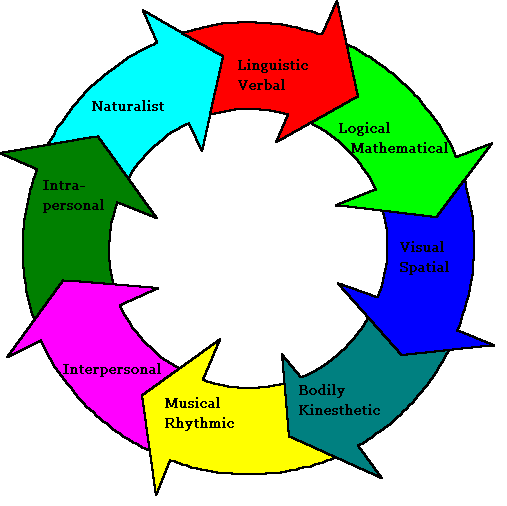
intellegencesMost of you are familiar with Howard Gardner’s Multiple Intelligences, so you know Linguistic Intelligence and Kinesthetic Intelligence are very different. Linguistic Intelligence is associated with verbal skills, people who “use words effectively.” Those with Bodily-Kinesthetic Intelligence have a “keen sense of body awareness” and “communicate well through body language.”

While holding a conversation over lunch with a person met at BEA, it occurred to me when these two intelligences are juxtaposed, you can manage almost any situation.  I have often written about the importance of using correct language for a given situation. When administrators and board members hear words such as “support” or “enrich” to explain the role of the library program they usually think it’s nice but not vital given budget constraints.  Using “information literacy” in discussions with parents is a turn-off since they don’t know what you mean.  By contrast, speaking the terminology administrators employ not only creates a better level of understanding, it also shows you are current with trends that matter to them.communication

Being active in your state and national library associations is another way to increase your credibility when promoting your library program.  The fluency with which you describe the value-added of an active library program positions you as an expert.  While your listeners might not agree with everything you say, your ability to be clear and targeted carries a great deal of weight.

Adding the kinesthetic aspect is newer.  It is well-known fact that most of our communication is not verbal.  Most people respond to the visual clues of body language without being aware they are doing so.  Skilled negotiators are alert to these “tells,” but once you make it a point to notice the signs, you quickly recognize when someone is agitated, impatient, or open. The more you watch people, the better you get at it.
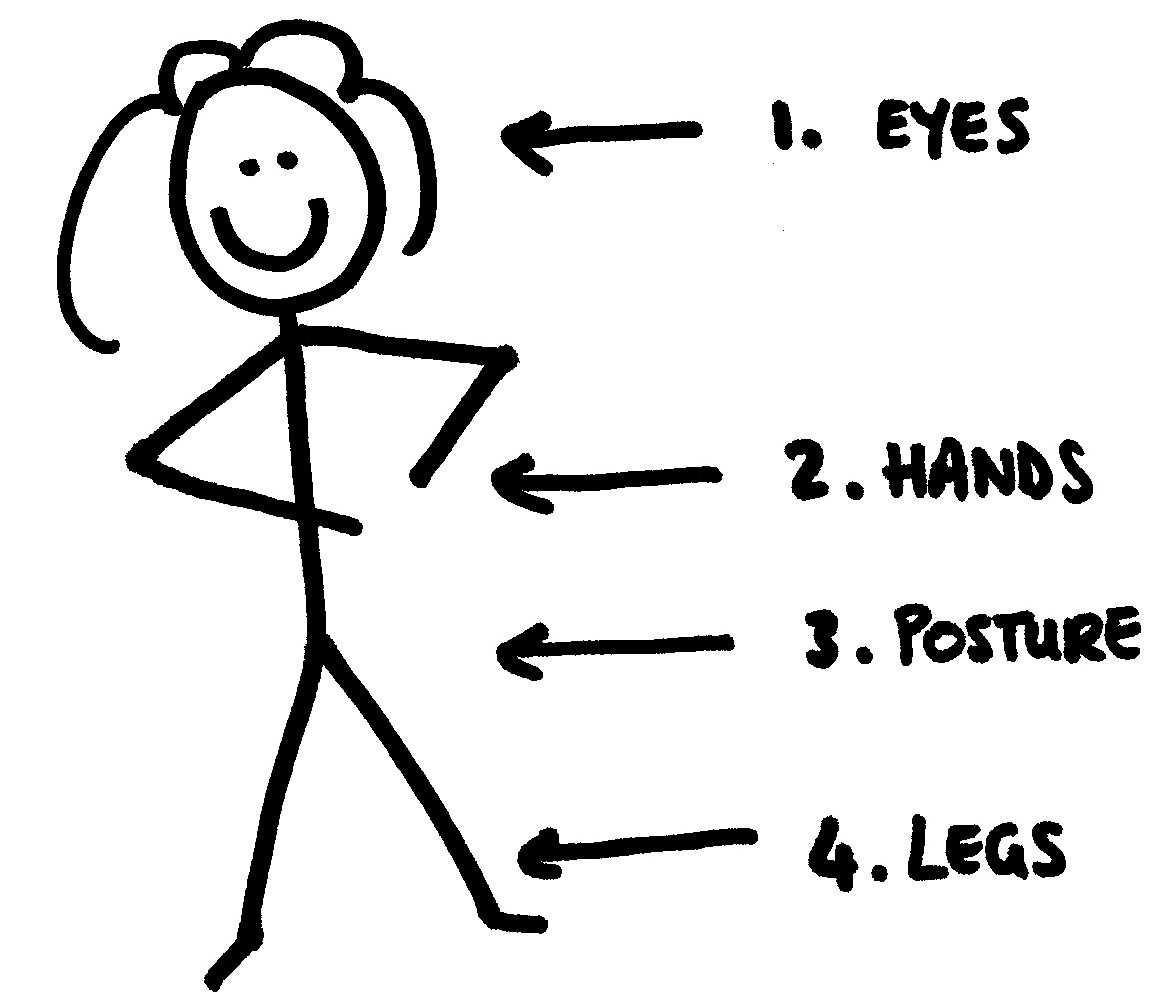
body languageWhile each of these intelligences is important separately, they become more powerful when used in combination.  Those with high kinesthetic intelligence always know where every part of their bodies are.  If you have linguistic intelligence you recognize the placement of your words in a conversation.  Is what you are saying sounding defensive, arrogant, or insecure?  Which of your words will best convey your meaning to the person listening?  Are you projecting your interest in their comments? And how are they responding to you?  What is their body language tell you?  If you watch you will learn about your listener.

Communication requires a sender and a receiver.  Often there is “noise” between the two parts (think static or a bad connection) that interferes with clear reception.  The higher your linguistic kinesthetic ability the less noise you will have when communicating with others.  It’s mash-up intelligence well worth cultivating.
Posted in Uncategorized

Remembering

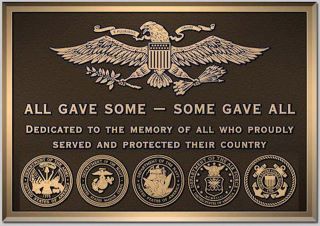
all gave someI am in a somewhat somber mood.  It is Memorial Day as I write this and all over the media, social and otherwise, the nation and individuals are recalling the fallen. I am glad to see how many of us are recognizing the great sacrifice our military has made throughout our history. For those who serve, and their families, the war never ends.

As a librarian, I always look for events that can be used to help our students make deeper connections and learn as they do so.  In this case, I am thinking less of those who gave their lives and more about those who have returned wounded in mind and body.  I have just completed a “Research to Go” activity on World War I which you will see in the August/September 2014 issue of School Librarian’s Workshop.  Begun one hundred years ago, “The War to End All Wars” proved we have no end to wars.  Then, and in the subsequent wars since, soldiers have suffered from what was called “shell shock” at the time, “battle fatigue” in World War II, and is now better identified as post-traumatic stress syndrome.  Additionally, as a result of IEDs (improvised explosive devices) veterans of Iraq and Afghanistan are dealing with more loss of limbs than in previous wars. we support

ww projectI am recounting this because I think it important for students to become good citizens and consider community service as part of their growth.  The Wounded Warrior Project has several ways students can participate from raising money to writing letters.  If your students are old enough to become involved and your school offers no impediment to do so, consider promoting it in your library.  Research other places which could use the support of students either locally or nationally including Kids In Support of Soliers. Work with kids who want to take a leadership role in this.  Make this Memorial Day mean more than a three-day weekend.

Tagged with: , , , , ,
Posted in General

Safe in the Library

great libraryAs librarians and educators we focus on ensuring our students get the information literacy skills and love of reading which will make them lifelong learners.  We work with teachers to cover Common Core requirements and deal with Lexile scores, complex texts, and the six shifts on a daily basis.  While these have a high priority, we cannot lose sight of the value of the library as a safe place for students both cognitively, emotionally, and personally.

From a cognitive standpoint, there is a reason educators talk about safe schools.  Learning cannot take place when students feel threatened. Safety is next to the bottom level of Maslow’s Hierarchy of Needs.  Once basic physiological requirements such as food and shelter are taken care of, safety is next, and one doesn’t rise on the hierarchy until the lower level is attained. When we feel threatened our adrenal system – the fight or flight mechanism – takes over, and blood is sent there, cutting off the cerebral cortex, the thinking part of our brain.  From a survival standpoint this makes sense.  If you are driving down an icy mountain road and your car goes into a spin, you don’t have time to think about which way you should be turning the wheel or why putting on your brakes is a bad idea.  You react, going on instincts.
Maslow

In a classroom, if a teacher criticizes a student for some failure to produce the right answer, most often the child is no longer capable of going through the thinking process needed to figure out where he or she went off track. The cerebral cortex has shut down.  How often have you seen that “deer in the headlights” stare when a kid is drawing a complete blank?  In that moment, the adrenal system is in control and critical thinking has gone out the window.

safe placeBy making the library a safe place, true learning can occur.  Many adults report memories of being bullied and harassed when in school but finding safety in the library.  It’s more than just a welcoming environment we create.  It’s a nurturing one.   Within the walls of the library, countless students have found the space to pursue interests and explore ideas without worrying about being ridiculed.  How many Steve Job’s, Joss Wedon’s, and Neil Gaiman’s have we inspired? It’s one of the great gifts we give students.

I have been in many great libraries. Some high tech and some barely tech.  Some are gorgeous and others haven’t had a face lift in years.  What the great ones have in common is they all feel like home, where you are accepted for who your are. To paraphrase an iconic film, “There’s no place like the library.”

Posted in Uncategorized

Declarations – Standing Up for Yourself and Your Library

Barbara Stripling PortraitI have been following the progress of the Declaration for the Right to Libraries, part of ALA President Barbara Stripling’s initiative.  Both as chair of AASL’s Advocacy Committee and as a staunch supporter of all libraries, with an emphasis on school libraries, I have been gratified by the reception it is getting from people outside the profession.  I am not sure how many have signed.  The number is growing as librarians hold signing events and share these basic principals with their many users.

Aside from the content, I particular admire the choice of the word “Declaration.”  The best definitions for it in this context are proclamation or pronouncement.  It is the proud statement of belief—what we as a profession stand for.  Making such a huge public announcement carries risk.  Some might argue with it or consider it was promulgated from self interest.  It takes courage to stand up for your beliefs.  It reminds me of the Declaration of Independence, a bold statement putting the lives of the signers in jeopardy.  While not as extreme, the Declaration for the Right to Libraries brings librarians out from our behind-the-scenes service and boldly asserts the value of what we provide.Right to Libraries

There is a lesson here for individual librarians.  Hiding your light under a bushel, doing a great job but not communicating it out loud, keeps you invisible.  And invisible all too often these days means eliminated.  Paraphrasing a famous quote, it’s time to “boldly go where librarians have not gone before.”  Get the word out about all the ways you work with teachers, students, and administrators.  Learn through Twitter, Facebook, conferences, (and School Librarian’s Workshop) the best platforms for reaching your target audience.  Share your successes so others can follow your lead.

Nora quoteI love this quote by Nora Roberts, “If you don’t go after what you want, you’ll never have it. If you don’t ask, the answer is always no. If you don’t step forward, you’re always in the same place.”  What do you want?  Do you really want to remain in the same place you are in?  What are you going to do about it?  Declare yourself!

Tagged with: , , , , , ,
Posted in General, Issues

Do You Dread The “A” Word”?

Libraries are about...What do you think of when I say “Advocacy?”

Do you want to back away in horror?  Hide in the stacks?  Change the subject? Well, stick with me for a few minutes and I’ll try to fix that.

As chair of AASL’s Advocacy Committee I have become aware that part of the challenge in building advocates for school library programs is the aversion lots of librarians have for advocacy.  For many, the word seems to suggest you are pleading with people to save your job, which is not attractive—nor should it be.  Others see all the toolkits and websites and wonder how they can add more to their already overloaded schedule.

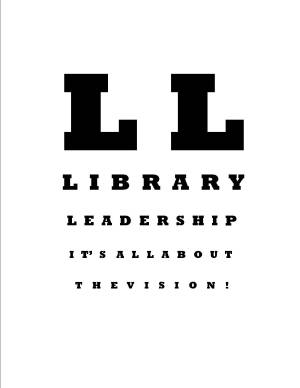
Equally worrisome is the “L” word – Leadership. Although several state associations hold reasonably well-attended summer Leadership Institutes, sessions on Advocacy and/or Leadership at a state or national conference tend to attract small audiences.  Attendees apparently feel they should put their time into more “productive” presentations on technology or Common Core.  Yet nothing is more vital to the success of your program than advocacy—and leadership.library leadership

Stripping away some misconceptions might help.  Advocacy is the antithesis of begging people to save your job.  Advocacy is being so indispensable to stakeholders they cannot imagine how they can get along without you.  I was once told to close my high school library for the morning so a meeting could be held.  I simply notified teachers we had to postpone their scheduled classes, and they went to the office in fury.  I never asked. The teachers didn’t think of themselves as “library advocates,” they were fighting for what they needed. (Ultimately, I only had to close a portion of the library.)

Leadership is not usually taught in library school.  There is an underlying belief you are either born a leader or you aren’t.  It’s true some are natural leaders, but anyone can learn.  I was never a leader in school.  I came to it slowly.  What I wanted as a librarian was to help my students and teachers.  To do so, I needed to be aware of trends and resources in librarianship, technology, and education and be willing to reach out—without expectations—and share. I had to focus on what teachers and students most wanted and find ways to give it to them.  Then I began sharing by writing about it.  Small steps get you on the path to leadership, but you must be willing to take the first ones.

MastheadEvery issue of School Librarian’s Workshop gives you tools to help you lead in your building and have stakeholders recognize you are indispensable to them—becoming advocates for your program.  If you want to speed your skills in this area, sign up for my ALA Editions e-Course, Being Indispensable:  A School Librarian’s Guide to Proving Your Value and Keeping Your Job. which is scheduled for June 9 – July 18, 2014.  And if you are ready to share your successes by writing about it – we may have space in the School Librarian’s Workshop for your article. Email me for more information.

How are you being a leader in your building?  What are you doing to become indispensable? And how can I help you?


Posted in Career

Role Model or Stereotype —Which Are You?

yes I need a librarianEven before economic conditions resulted in drastic cuts to school library programs, if you worked in an elementary or middle school you were likely to be the only librarian.  Now it is true in many high schools as well. While managing all the many responsibilities you have—and these have increased in most places—you probably have not stopped to consider how you are being perceived by your stakeholders.

stereotypeFor good or ill, we become the image of a school librarian to all the people we see in our buildings.  We are all familiar with the classic shushing librarian stereotype with glasses and hair in a bun, but that one is mostly disappearing (thank goodness!) except for references in books and films to someone dressing “like a librarian.”  The question is, “what is replacing it?”
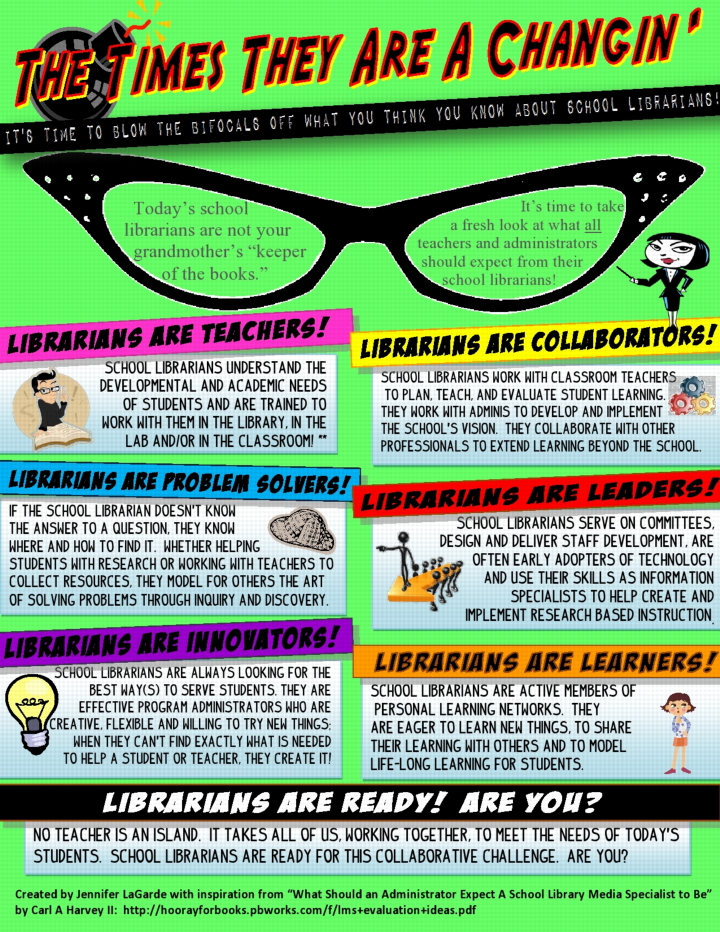

Some of the new stereotypes are: rule-driven librarians, feeling such pressure they focus on keeping the library under control, librarians who are too busy with their job to participate in school-wide events and celebrations, and school librarians who see no library connection to Common Core and other teacher concerns.  You can probably come up with more.  The damage done by these stereotypes is enormous.  A principal with such a librarian will believe librarians contribute little to overall student success.  When faced with the need to make cuts, the decision is easy.  Worse, if and when that principal becomes a superintendent of schools, that stereotype will impact all the librarians in the district no matter how great they are.

From http://www.librarygirl.net/

From http://www.librarygirl.net/

On the other hand, there are many librarians out there who are role models for what school librarians add to the vitality of the school community.  They are the ones who are showing teachers and students the newest websites and apps for teaching and learning (see those listed on the AASL website (http://www.ala.org/aasl/standards-guidelines/best-apps and    http://www.ala.org/aasl/standards-guidelines/best-apps).  They model inquiry-based learning, engaging their students in the process of discovery and creating new knowledge.

The outstanding ones are bloggers, tweeters, and creators of chats.  Their websites are dynamic, showcasing how the library program is integral and vital, using a broad assortment of resources to do so.  Teachers, students, administrators, parents, and even the community look to them for help. Their enthusiasm is contagious.  This is the role model—or new stereotype—we want to be seen everywhere.

What are your strengths as a librarian?  How can you showcase this so more people are aware of the great things you are doing with students and teachers and for the community?  Are you willing to become a role model?

Posted in Uncategorized

Spring Cleaning – Time for a Change?

In medieval times, the year began with spring.  Despite our starting the calendar year in the middle of winter, we still look to spring as a season of renewal.  In my childhood, most women made a point of spring cleaning.  Certainly the Easter and Passover holidays encouraged that.  It was good to air out the house and make it feel as fresh and clean as the outdoors.

spring cleaningWhile some people still maintain the custom, I think many of us are so busy our efforts are more slapdash than concerted.  Yet the idea has merit.  I don’t only mean house cleaning—although it’s something I probably should consider as well.  I think this is a good time of year to do some mental house cleaning.

The school year is entering the final phase and you are probably working at full speed to meet the demands of teachers and students.  How is this year different from the past?  Is Common Core the only change?  Are you still doing what you have always done?dusty

“If it ain’t broke—break it.”  Good leaders never say that out loud as it generally causes alarm in those who like certainty rather than change in their lives. But the concept is to avoid complacency.  If you only do what you have always done, you don’t explore the new and (possibly) risky.  But without risk and change there is no innovation – no rewards.

Jim Collins has said, “Good is the enemy of great.”  When things are working, you are willing to accept the status quo, but remember nothing really remains in stasis.  If you are not growing and improving you are decaying and falling behind.  The questions that always need to be asked are: “How can this be done better?”  “What would I go for if I had all the funds and support I needed?”  Why would that be a good idea?

keep  calm and embrace chaosAnd about the risk factor – remember leaders take risks.  Another quote that’s can be scarier than the others—“Chaos is good.”  If you can keep your head when things are chaotic, you can find opportunity within it.

Are you embracing change?  How are you spring cleaning your program and “mental” attic?

Posted in Uncategorized

Live Long and Prosper – Are You Creating New Avenues for Outreach?

live_long_and_prosperThe famed Vulcan farewell is an ongoing commitment I have to school librarians and their programs, yet everywhere they are being threatened with elimination. What can you do to turn the tide?  The answer is a 3×3 strategy for winning stakeholders.

The first threesome consists of PR, marketing, and advocacy. AASL has simple definitions for the three on its website http://www.ala.org/aasl/advocacy/definitions.  PR and marketing are tools for building support from stakeholders.  We are not supposed to be the ones advocating.  Others should be doing it for us. The challenge is getting them to recognize why they need us.

I have come to realize that the word “advocacy” isn’t resonating with anyone. It has become more of a plea for help in saving our jobs, making us sound weak and needy. Not an image we want to cultivate.  How did that happen, and what can be done to change it? advocacy

My suggestion is to begin with another threesome: leadership, networking, and legislation.  Leadership is first.  People must know who you are and what you give them.  Note that what you give them must be what they want, not what you think they need.  It requires that you get to know your stakeholders and what they value and then be visible in meeting those needs.  (Use PR and marketing to help get the word out.)

Networking means outreach and creating relationships.  Who do you know?  How do you leverage those contacts?  What do you give them?  How do you acknowledge them?  Are you using current methods i.e., social media to maintain the relationships?

Finally become politically aware.  Challenges to your program don’t always arise at the district level. Both state and federal governments have negatively impacted our programs.  Get alerts from ALA’s Washington Office http://www.ala.org/wo and respond to requests to contact legislators.  Better yet, ask your network to do as well.  It takes almost no time.  Find out what your state association is doing with legislation.  Know your local government officials and look for ways to make them welcome in the library—with photo ops.

Outreach and engagementIs this time consuming?  Yes!  But putting in the work here (you can create a targeted strategic plan for doing it), could be just what is need to insure you “Live Long and Prosper.”  I know many of you are doing this. How did you reach out? What do you suggest to fellow librarians?

AND –  If you want help – consider taking advantage of SLW’s new program of “ASK HILDA!  Send me an email at hilda@slworkshop.net and I’ll be in touch. 

Tagged with: , , , , , , , , ,
Posted in Career, Librarian Life

Do You Plan Your Year Strategically?

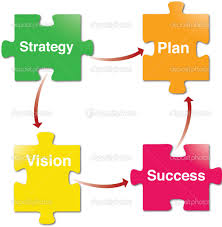
plan successHow will you be feeling at the end of this school year?  Will you be able to look at what you have achieved or will you be like so many librarians who are exhausted, knowing they worked hard but not being sure what they accomplished?  Among the many workshops I present, one of my favorites is Plan for Success—or Plan to Fail: Small Scale Strategic Planning.

You may think strategic planning is for business or for organizations such as AASL or your state library association, and you are partly correct. They do develop three-year plans with the help of a facilitator and sometimes focus groups.  That is beyond what you can or need to do.  You can develop a strategic plan for your program by yourself—or with the help of a few colleagues if you know what is involved.strategic plan

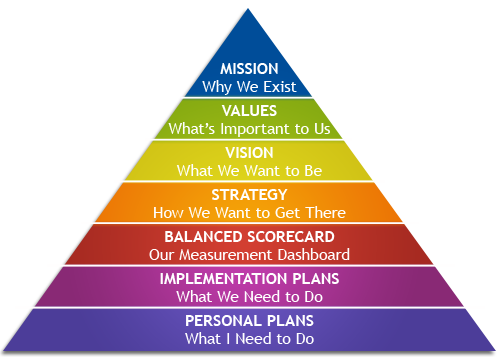
To create a strategic plan, you must have a Vision (or a huge, audacious goal), a Mission Statement, Goals, and Action Plans. Your Vision should be how your program would be if it were a perfect world.  It may be unattainable for now (or maybe ever) but that’s what you most want. Your Mission Statement defines your purpose, your reason for being.  Keep both statements under 50 words and make sure they are compelling, and appealing to anyone who would use or visit you library. Mission and Vision Statements should be hung near the circulation desk for all to see.

Goals should be an outgrowth of the Vision and Mission and be ongoing for several years.  For example, you might want to increase leisure reading by students or expand student awareness and skills in using databases and web resources.  Don’t have too many Goals. For each one you need one or more Action Plans. An Action Plan for the first example might be to create a school-wide reading program while for the second it could be to work with teachers on a pro/con paper including an annotated bibliography for all sources.

strategic-planning-hierarchyYour Action Plans need to written below the Goal to which they apply along with three key components: Who, When, and How Did It Go.  Who specifies the person responsible for each step in carrying out the plan.  When identifies the start and completion date, and the last step is an honest assessment of where it worked and where it didn’t. Don’t be afraid to make adjustments as needed to be sure the Strategic Plan stays active.

At the end of the year, review your Strategic Plan and develop new Action Plans for your Goals. If you have questions, post them here or on the School Librarian’s Workshop Facebook page.


Posted in Uncategorized

Do you make time for yourself?

busy busy busy
In October, I blogged about the importance of “Downtime.”  I stressed the need to make space in life for family and friends despite our increasingly hectic lives.  As demands on my time have been greater than usual the past weeks and will continue this way for the next few months, I recognize the importance of taking time for my other interests. It’s how I stay sane and not aggravate everyone around me.

Writing fiction is one of my great passions so I spent last Saturday at the Liberty States Fiction Writers Conference enjoying being with other writers, readers, and bloggers.  Now that Woven Through Time is available, I am ready to be thinking about what comes next. I don’t want to stop with just one book in publication.  I have another started, a picture book done, and a two-page beginning concept for a sequel to Woven through Time.  These are as important to who I am as is School Librarian’s Workshop, the second edition of New on the Job, and the ALA Editions e-course on Being Indispensable, scheduled to begin early in June.writers conference

The Conference was wonderful for me.  I met lots of people, made some contacts and possibly a new friend.  I learned about making sure my plots contained all the elements needed for a well-constructed story, how to pitch to an agent, and how to write a query letter and synopsis that sell.  All in all, a thoroughly enjoyable day.  I returned home feeling inspired, my creative juices once again stirred up. While it’s several months down the road, I have a date on my calendar for returning to those stories on hold.

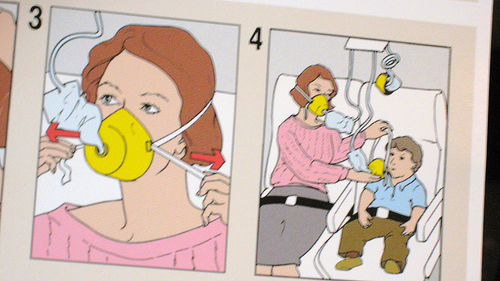
oxygen-maskFlight attendants caution us to put the oxygen mask on ourselves before helping someone dependent on us.  We can’t help others unless we have taken care of ourselves first. What do you love to do?  When was the last time you did it?  Get it scheduled back in your life. You will be glad you did. Those you love will be glad you did.  And all the tasks on your to-do list?  The important ones will get done. They always do.

Posted in Uncategorized